

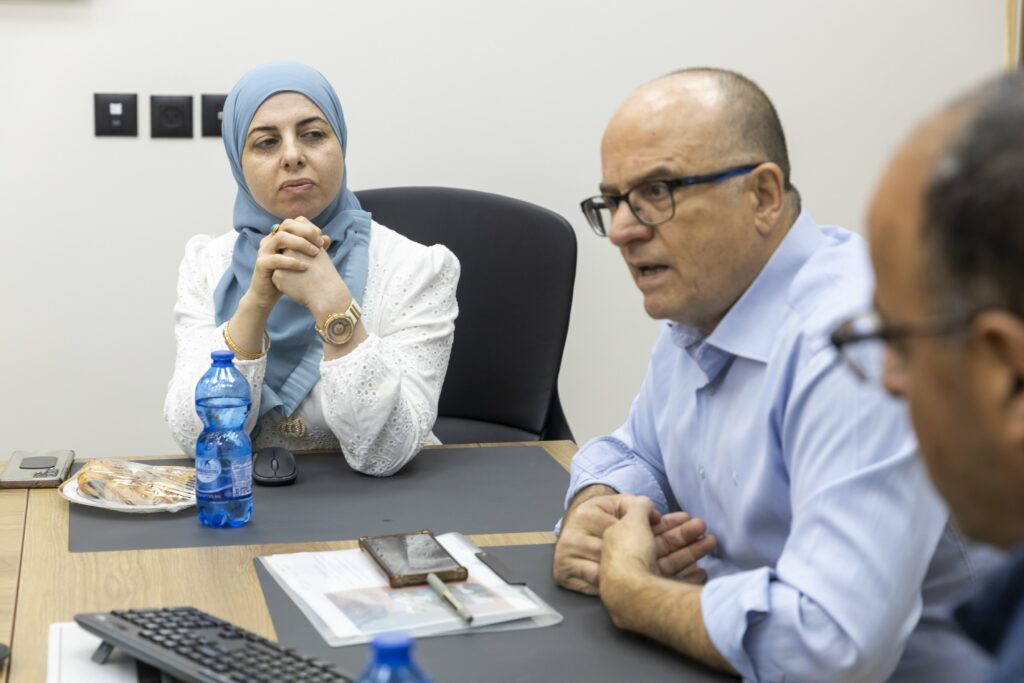
This interview was conducted as part of a press tour for Russian-speaking journalists in Israel, organized by the Mossawa Center. The tour took place in the town of Baqa al-Gharbiyya—an Arab locality located directly on the Green Line. The eastern part of the town, Baqa ash-Sharqiyya, lies on the other side of the separation wall, in Palestinian territory. During the visit, the participants toured Al-Qasemi College—a unique academic institution that blends Islamic roots, academic independence, and multicultural thinking. Our interlocutor is Professor Muhammad Amara, President of the College.
– Professor Amara, could you tell us about the history of Al-Qasemi College?
– The college was established even before the founding of the State of Israel, as a religious Islamic educational institution—initially as a school attached to a Sufi mosque library. At first, men and women studied separately, focusing solely on Islamic sciences, particularly Sharia. Today, it is the only college in Israel where Islamic sciences are still taught at an academic level. But much has changed since then. Education is now coeducational, and we offer more than 20 different specializations—from English and mathematics to pedagogy and management. The college is recognized by the Ministry of Education: since 1973 we’ve been issuing teaching certificates; since 2002—bachelor’s degrees (B.Ed.); and recently—master’s degrees (M.Ed.).
– Women’s education in Islamic society often sparks debate. How do you see Al-Qasemi’s role in that context?
– This is an important question. We are proud that our college has become a pioneer in promoting women’s education in the Arab and Islamic context. Today, over 70% of our students are women. That’s not just a statistic—it’s a social shift. We’re witnessing the rise of a generation of educated, confident women who are capable of shaping society, transforming mindsets, and leading. The Sufi tradition, upon which the college was founded, never opposed women’s access to knowledge. On the contrary, spirituality in Sufism is a path open to all. We are simply continuing that tradition in a modern academic form. For many of our female students, Al-Qasemi is a space of freedom and growth, where they can study, work, and dream. That’s what I call true reform from within.
– The college has Sufi roots. How do those manifest in your current activities?
– Yes, Al-Qasemi was founded by members of the Sufi tariqa that bears the same name. It’s a moderate stream in Islam, focused on spiritual practice, good deeds, and personal growth. Sufism does not interfere in politics, and that’s a principle we uphold. The founders of the college donated over 100 dunams of land to establish the campus. But it’s important to understand: we are a secular academic institution. The Sufi leadership does not interfere in academic policy. Islamic studies here are strictly academic, without sectarian bias. The mosque on campus is open to everyone, regardless of religious affiliation.
– What values do you seek to instill in your students?
– First and foremost: pluralism, social responsibility, a thirst for knowledge, and respect for others. Our faculty includes Muslims, Christians, and Jews. We are educating not only teachers but also leaders. We believe that high-quality education can transform society.
– What is Al-Qasemi College today?
– We have about 4,000 students. We are part of a larger educational complex that includes institutions ranging from kindergartens to an applied engineering college. Our faculty includes both Arab and Jewish scholars. The college has been recognized as a “green campus,” and we received a quality award from the Prime Minister’s Office. Recently, we were included in the list of the 12 leading academic institutions in the world for our multifaceted contributions. We have a large library—with more than 80,000 titles—as well as our own archaeological museum.
– Tell us more about the museum.
– It’s a small but very important project for us. We created the museum in collaboration with the municipality and the Israel Antiquities Authority. It displays artifacts from the surroundings of Baqa al-Gharbiyya and Jatt, dating back up to 3,000 years. Among the exhibits are whole Canaanite amphorae found in caves, and a replica of a clay tablet with cuneiform writing, on which the king of Jatt complains to the Egyptian pharaoh about the king of Shechem. The word “Baqa” in Arabic means “bouquet”—a beautiful reflection of our approach to education.
– What are the main challenges you face as head of the institution?
– One of the most pressing is the language barrier. Young people come to us with poor Hebrew skills. But to enter university, they must pass the YAEL Hebrew proficiency exam. We offer mandatory Hebrew courses at the college’s expense, but this requires state support. Another serious issue is excessive interference from the Council for Higher Education (MALAG). They demand scientific publications from us as if we were a university—but without providing corresponding funding.
– How do you assess the situation of Arab students in the Israeli education system as a whole?
– Every year, around 70,000 Arab students begin their studies—about 50–58 thousand in Israel, and the rest abroad, in Jordan, the West Bank, or Turkey. At the same time, there’s a paradox: the Arab sector has a surplus of teachers, the Jewish sector a shortage—but Arab teachers are rarely hired in Jewish schools. Out of 200,000 teachers in the Israeli education system, only about 1,000 are Arab. This is a barrier that must be overcome.
– You also mentioned the media space as part of the problem.
– Exactly. Arab families in Israel have long switched to satellite TV: Al Jazeera, Sky News Arabia, Turkish dramas. The Russian channel RT also broadcasts in Arabic. Israeli channels are becoming increasingly irrelevant for Arab viewers. It’s a kind of isolation. Jews watch only in Hebrew, Arabs only in Arabic. There is no point of contact. We tried to create a television platform, an incubator for children’s content—because language begins in childhood. But without state support, it’s extremely difficult.
– What are your future plans?
– We plan to open branches of the college in the south of the country and in the “Arab Triangle.” We are investing in teaching quality and technology. But the most important thing is to never forget that behind every student is a personal story. We must give them a chance. Education is our contribution to a sustainable peace.
Photos by Elena Rostunova
Facebook: https://www.facebook.com/helena.rostunova/
Instagram: https://www.instagram.com/erostunova/