

Last week, we published an article following our visit to the town of Baqa al-Gharbiyya, organized by the Haifa-based Center for the Rights of Arab Citizens in Israel, Mossawa.
In that piece, we highlighted the problems facing the Arab sector—problems created by the state. They often go unnoticed, yet they significantly affect all of us.
We promised a continuation of our small journey. The next chapter took us to two villages with the same name—Barta’a. One lies within Israeli territory; the other is part of the Palestinian Authority (PA).
In western, Israeli Barta’a, we visited the local council building, where we were welcomed by its head, Raed Kabha. The building resembles a small palace—modern, spacious, and well-designed. On every office door, signs appear in both Arabic and Hebrew, creating the impression that the state is genuinely invested in its institutions. The village itself is also quite aesthetically pleasing.
Raed Kabha heads the local council that includes three villages: Barta’a (his hometown), Mu’awiya, and Ein Sahala, with a combined population of about 13,000. Kabha noted that the state has indeed invested in these villages—each has modern schools, soccer fields, and sports halls. The level of education is rising steadily: 76% of high school graduates receive matriculation certificates. Thirty years ago, the area had only three doctors; today, there are 180.
An idyllic picture? Not quite. There are many obstacles created by the state. Kabha has held his position for 12 years. In his first year, he submitted documents to all relevant authorities to build a new neighborhood for young families. Only now, after all these years, have the long-awaited permits finally arrived.
In recent years, birthrates in Israel’s Arab sector have been steadily declining. Today, the average birthrate among Arabs is already lower than that of the Jewish population—a major demographic shift, reflecting deeper social and economic challenges.
One key reason is the acute housing crisis. Young Arab families face near-impossible odds when trying to build a home: land is scarce, and permits are entangled in bureaucracy and years of delay. Many resort to building on agricultural land or adding floors to existing homes that weren’t designed for such expansion. Others move to Jewish towns—like nearby Harish, which is rapidly developing and drawing Arab families from the area.
To the housing problem is added the lack of industrial and commercial zones in Arab localities. This forces workshop owners, small manufacturers, and auto service shops to operate out of residential yards. Both in Baqa al-Gharbiyya and in Barta’a, the issues are similar. This practice lowers quality of life and creates ecological and public health risks.
Together, these factors—housing shortages, lack of infrastructure, bureaucratic hurdles—have a direct impact on quality of life, birthrates, and social stability in Israel’s Arab society.
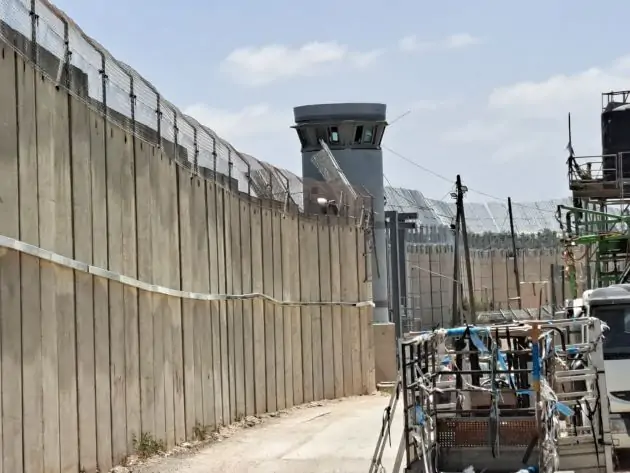
It took us just a few minutes to drive into eastern Barta’a, located in the Palestinian Authority. And here, we were in for a surprise: there was no notorious checkpoint, no separation wall! We entered the village freely. No soldiers, no police—our entry wasn’t recorded anywhere. Yet this is not considered a particularly safe area for non-Arabs. Still, on weekends and holidays, thousands of Israelis drive through from Israeli to eastern Barta’a.
We arrived on a weekday. Few cars. The main street looked neglected—as if we’d crossed into the third world. Although it is within the PA, many signs are written in Hebrew.
We entered a modest building. The stairwells were run-down. We were headed to meet Abdullah al-Kabahu, head of the local authority. His office and reception hall were a stark contrast to what we had seen in the Israeli part—far more modest. Al-Kabahu was already seated. Behind him, portraits of Abu Mazen and Arafat hung slightly crooked on the wall. Our escort whispered something to him as we sat. Apparently suggesting to adjust the setting. Al-Kabahu merely straightened Arafat’s portrait.
He told us that before 1948, both Barta’as were a single village. After the founding of Israel, a ravine split them apart. The situation is extremely complex: eastern Barta’a is part of the Palestinian Authority, but lies before the separation wall and is under full de facto Israeli control.
The village has unofficially become a free economic zone. Unlike the Israeli side, no VAT is paid here, and all goods brought in from PA-controlled areas are far cheaper than in Israel. This might sound beneficial, but according to al-Kabahu, it creates major challenges. Around 7,500 people live in the village, but at night, 20,000–25,000 stay there. The infrastructure can’t handle it. One reason is that the Israeli army checkpoint closes at 6:00 p.m. Residents need Israeli permits just to live in their own homes, and face many difficulties crossing the checkpoint. As a result, they are restricted in access to healthcare, jobs, education, and more.
The “free zone” status has its upsides, too. Many PA-based business owners have relocated their workshops, factories, and stores to Barta’a. Many operate at night. Every day, 26 trucks bring in goods, food, tools, and spare parts. According to the village head, by the weekend, Hebrew is heard more than Arabic in Barta’a.
How safe is it for Jews in Barta’a, where neither Israeli nor Palestinian security forces operate? “Here in Barta’a, we’re one big family and we take responsibility for those who visit us,” says Abdullah al-Kabahu. Not exactly a comforting guarantee.
What’s the conclusion from our visit to Baqa al-Gharbiyya and the two Barta’as? The State of Israel is creating obstacles not only for PA residents but also for its own Arab citizens. A few simple policy changes could improve lives, rebuild trust, increase loyalty, and promote integration into Israeli society. Unfortunately, someone seems to benefit from the current situation—it maintains tension, fuels resentment and stereotypes. In this unequal battleground, human rights activists try to make a difference. Sadly, not always successfully.
We hope to soon interview Mossawa’s leader, Jafar Farah, to discuss the issues facing Arabs in Haifa and the persistent stereotypes among Russian-speaking residents of the city.
Avner Korin, Olga Gorevaya
Photos: Authors