

In the late 1990s, the Mossawa Center for the Rights of Arab Citizens in Israel was founded in Haifa by Jafar Farah, who remains its director. Mossawa is one of the few human rights organizations whose work is covered in Russian-language media. It raises awareness of the challenges faced by Arab citizens of Israel—many of which are artificially created by the state itself.
To better understand the reality of the Arab sector, we set out on a tour of several towns in central Israel and one village in the Palestinian Authority.
Baqa al-Gharbiyye – A “Bouquet” Between Two Worlds
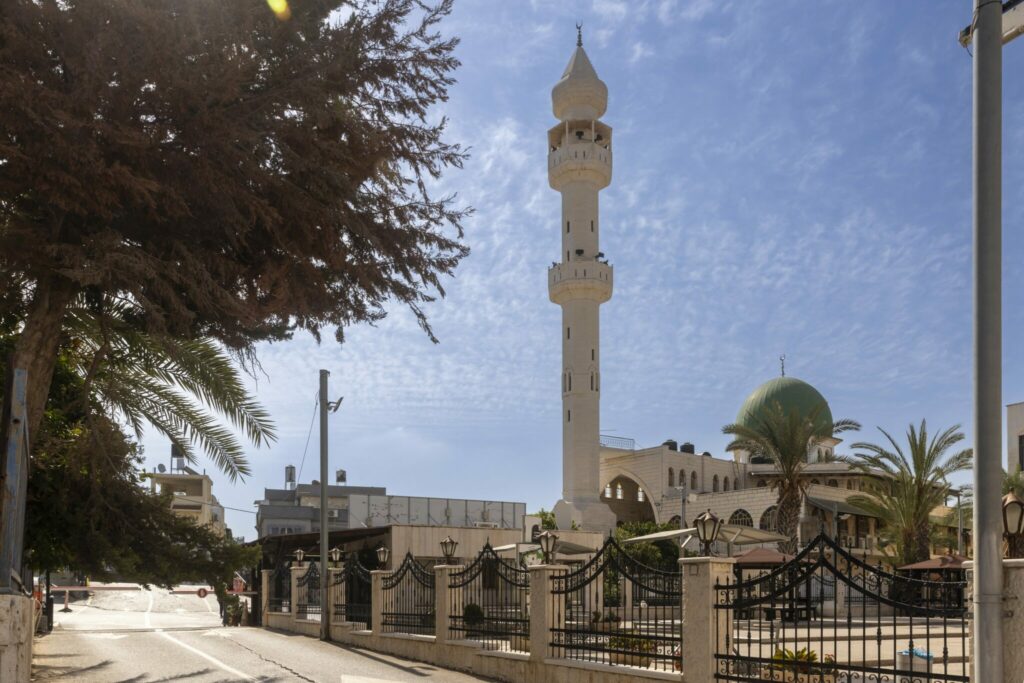
Our journey began in Baqa al-Gharbiyye (often referred to simply as Baqa), home to over 30,000 residents. The city’s name in Arabic means “bouquet” or “stream of flowers.” Its central landmark is the Al-Qasemi Academic College—a modern campus that blends tradition, culture, and contemporary education.
According to college president Professor Muhammad Amara, the institution was originally focused solely on Islamic studies. Over time, however, it transformed into a secular educational establishment offering a wide range of disciplines. Today, students can earn bachelor’s and master’s degrees in education-related fields.
The college was founded by a Sufi order that donated around 100 dunams of land for its creation. Despite its religious origins, the administration does not interfere with academic activity. Teaching is carried out in a neutral manner, without emphasizing Sufi interpretation.
The college’s library, with over 100,000 volumes, is one of the largest Arabic-language academic libraries in Israel. It maintains strong ties with other libraries across the Middle East and is regularly upgraded.
There is also an archaeology museum on campus, based on a private collection donated by local historian Ibrahim Abu-Hussein. Exhibits include unique 3,500-year-old amphorae and a replica of a cuneiform tablet in which King Jata complains to the Egyptian pharaoh about the ruler of Shechem.
Al-Qasemi College is not only a cultural center, but also an economic hub: thousands of students energize Baqa’s streets daily, supporting small local businesses.
According to Professor Amara, the college faces many challenges: from bureaucratic hurdles imposed by the Ministry of Education to difficulties in launching new academic programs. Arab towns remain largely excluded from national education policy—most universities are located in Jewish-majority cities. As a result, more than 10,000 Arab citizens of Israel pursue higher education in the Palestinian Authority.
Wells, But No Work
We leave the college and stop near a traffic junction, where a well has been preserved. It turns out that even after the founding of the State of Israel, residents of Baqa drew water from wells. It was not until 1955 that the city was connected to a water supply system through Mekorot, the national water company.
Ironically, while Jewish schools across Israel face a severe shortage of teachers, the Arab sector suffers from an oversupply of education graduates. However, due to declining Hebrew proficiency among Arab youth—caused by increasing isolation in Arab communities where services are offered in Arabic and contact with Jews is minimal—these graduates face barriers to employment in Jewish schools. Professor Amara believes the state should support Hebrew education in Arab schools as a key element of integration.
Everyday Challenges
Like many Arab municipalities, Baqa al-Gharbiyye has no designated industrial zones, and approval for developing such zones is delayed for years. This hampers economic growth and fuels informal employment.
One notable stop on our tour was a visit to makeshift workshops set up in private home courtyards. There are about 350 such enterprises in Baqa al-Gharbiyye. Due to the lack of industrial zones, businesses operate in residential areas, creating frequent conflicts between neighbors.
We head to the outskirts of the village. Here, a separation wall runs through the landscape. On the other side lies Baqa ash-Sharqiyya, which is part of the Palestinian Authority. Several houses near the wall—on the Israeli side—are inhabited by people from Baqa ash-Sharqiyya. As a result, these residents live in Israel but hold Palestinian Authority citizenship, leaving them in a legal limbo. To make matters worse, the surrounding area has become a local dumping ground.
Land and Water – Resources and Obstacles
One of the most pressing issues is the expropriation of Arab-owned land for state infrastructure projects. Construction of highways, including Route 6, often involves land seizures without compensation or regard for local residents’ needs.
Agriculture is also under pressure. Due to land shortages, farmers must resort to year-round greenhouse cultivation. Yet they receive far less government support than Jewish farmers in moshavim and kibbutzim.
Water supply is another critical issue. Arab farmers are forced to form private associations to purchase water from Mekorot—often at inflated prices and with unreliable supply.
As our guide Ibrahim put it:
“A country surrounded by enemies should support every farmer who can ensure food security in tough times, regardless of their origin.”
Coexistence Is Possible
After a busy morning, we had lunch at a local restaurant. The deputy mayor of Baqa, who joined us, emphasized that good neighborly relations persist between Jewish and Arab residents in the region. Baqa residents shop at nearby Jewish malls, and Jews from surrounding towns frequent local Arab businesses.
Perhaps the main takeaway from this part of the tour is that Baqa’s residents see themselves as law-abiding citizens of Israel and want to be treated accordingly—expecting the state to resolve the pressing issues described above.
In our next article, we will cover the two neighboring villages we visited in the afternoon—Barta’a on the Israeli side and Barta’a in the Palestinian Authority.
By Avner Korin
Photo: Elena Rostounova